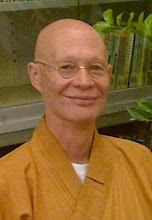
T'ai Shen Centre: A space for Chinese Pure Land Buddhism

Mindfulness within our Buddhist Practice is not just some technique but a total way of life. The ways of the world are concerned with creating results. Our practice is about creating Causes - the causes of Compassion, Wisdom and Happiness for all beings.


Showing posts with label Buddhist Meditation. Show all posts

Friday, February 18, 2011

Pure Land Experience

When I first came to Guang Jue Monastery over two years ago I was delighted that the abbot, the Venerable Zheng Rong, had invited me to stay with him. I asked him if he would teach me more about Pure Land Buddhism. His answer was abrupt and I felt my nose a little out of joint when he replied: “If you want to learn about Pure Land Buddhism go and read about it in books’, upon which he retired to his room. It was not until a day or so later the Master added with a smile: “But if you want to experience Pure Land, stay for a while.”

The Venerable Zheng Rong was not discrediting the importance of study and reading. However, I have always been amazed at the very few books on his shelf in his office. He was merely making a strong point that we can become bogged down in the academia of Buddhism without ever having an experience of its sheer beauty. You can read all you like about Pure Land Buddhism but until you actively practise it you will never know its fruits.

Pure Land Buddhism is a very “active’’ Buddhism. Its foundation is based upon Faith, Vows and Practice. The faith that Pure land Buddhism talks about is a very experiential faith. It is not a blind faith. It is not a faith that the Amitabha Buddha will give us a free ticket to the Pure Land on our demise and that is all to it. No! Faith in Amitabha’s power is grounded in the experience of Pure Land in this very moment, in the Samadhi of being an integral part of all nature. The Venerable Master Hsuan Hua stated , “You must understand that the Land of Ultimate Bliss and the Saha world are not beyond this very thought.” When we begin to realize that the Pure Land is in our midst then we are able to experience the beauty and joy of life. This experience is not just a mental factor. It evolves as a product of our relationship with all sentient beings and with all of nature. It is active.

When, as Pure Land practitioners, we make vows to escape the cycle of birth and death and to rescue all sentient beings to do this we must develop the Bodhi and Compassionate mind - a mind of compassionate action in relationship with one another.

The third foundation is “practice.” To practise not only means the absorbing of our mental focus in the recitation of meditation on the name of Amitabha Buddha but also in the daily experience of being Amitabha Buddha to all beings through our thoughts, words and actions.

One morning the Master asked me if I would like to go to the village with him. We walked along the little country lane beside the monastery passing the corn and rice fields. The air was crisp in the autumn morning. As we turned to walk along the main road there in front of us was a truck whose driver was trying to start the motor. It had broken down in the middle of the road. With my limited knowledge of mechanics I guessed the driver had run out of petrol or there was a problem with the fuel line. The Master, however, stopped to offer assistance. He suggested we try to push-start the truck. Push-start a truck??!! There were only two of us and the truck was of rather large proportions. We both strained to gain momentum. The truck surged forward, spluttered then came to an abrupt halt. “No matter”, came Master Zheng Rong. “We will push you to the village.” I gasped for air! The occupants of a few cars that drove past were aghast to see a Venerable pushing a truck. Finally a large truck with laborers stopped and asked if we needed help.

We eventually arrived at the village huffing and puffing. One of the laborers remarked: “We should tell the abbot of the monastery that you are a hero, old monk. He is probably having his morning meditation”. The others laughed. “I am the abbot”, smiled Master Zheng Rong. “This IS my meditation.” The laughter suddenly stopped. With hands clasped the workmen bowed. I felt the awe of the moment. “Stop your bowing and let’s have tea together!” retorted the Master with his cheeky grin. In a little while we were all together drinking hot local tea and sharing stories. Laborers and monk; Chinese and a Westerner rubbing shoulders in camaraderie. This is Pure Land. I understood the Master’s teaching.

Tuesday, October 19, 2010

A Pure Land Buddhist Master of Faith and Simplicity

When I first asked Master Zheng Rong to teach me the way of Pure Land Buddhism his response was for me to read about it in books. He waved his hand stating: “Books can teach you more than I can”. At first I felt a little put off by his remark. It wasn’t until some time later I was able to appreciate the depth of his humility and simplicity, two of my hardest lessons.

Humility is a great gift of so many Chinese Buddhist teachers. So, I would need to observe and observe closely. I intuitively knew that opportunities would arise.

The Venerable Zheng Rong is abbot of the Guang Jue Monastery of the Pure Land school in China. He is a man of great faith and simplicity.

I remember once reading about the life of butterflies in a book I had borrowed from the library. It was not until I sat still in the garden and observed the butterflies and their life that I really began to understand them. In a similar way I needed to be in the garden of the dharma to really understand. It was not until I lived and worked side by side with Master Zheng Rong that I began to understand his teachings.

I do not know a lot about his formative years as a monk. He does not think this important. It is the “now” moment that really counts. He has a dream for the future but again that is very grounded in reality of the present.

The Venerable Zheng Rong is immersed in daily life. He is not a monastic figure removed from public life behind the walls of a monastery. It is common to see him riding back from the small town of Zaoxi on the back of someone’s motorbike robes flapping in the wind with a cheeky grin on his face. He loves life. Other times you may see him ambling along the rural road chatting to farmers or townsfolk as he passes by. On another occasion I was walking with him to Zaoxi town to catch a bus to Lin’An when we came across a farmer’s truck broken down in the middle of the road. It seemed this poor fellow needed a push-start. Master Zheng Rong motioned to me to help him push the truck. Passing motorists seemed aghast at the sight of the Venerable pushing a truck and eventually one stopped to help. Dharma in action!

This is Pure Land Buddhism. These and many more were the valuable lessons I was to learn from my Master. Pure Land is about full engagement into life. After all, the Amitabha Buddha is the Buddha of infinite life and light. It is not just about some heavenly realm we may happen to enter into at the end of our days. Pure Land is something that can be very present and very real right now.

Unfortunately our world has become very polluted and overcome with many natural disasters and tragedies. Unfortunately most of us dismiss them as “natural” disasters without seriously contemplating the real meaning of the word. Master Zheng Rong speaks of the as disasters which are ordered by a natural law of cause and effect. It is because humankind has become polluted in mind that the seeds of the causes and conditions are planted that give rise to such human calamities.

On occasions Master Zheng Rong will speak with great animation about the Buddha’s teaching about everything arising from the mind and the necessity to plant seeds of purity and goodness.

One morning I met Master Zheng Rong dusting around the Maitreya Bodhisattva at the first temple hall. Master was smiling at the “Happy Buddha” as he is often referred to in the West. It is no mistake that this Bodhisattva is the first one we meet when entering the temple. He sits there with a broad and welcoming grin. His big belly is symbolic of the big heart and happiness that comes from following the dharma. In his right hand he holds Mala beads symbolic of the need to follow the dharma if we are to follow the Buddha Way and the ensuing happiness of life. My Master finishes dusting around the statue and smiles gently at me. He gestures to the Maitreya Boddhisattva and says in Chinese: “Hen Hao” . . .”very good.” Dusting done, the day begins. Another deep lesson in Pure Land.

Malcolm Hunt is an international Mindfulness Trainer and Retreat Facilitator at Guang Jue Monastery, Zaoxi, Zhejiang Province, China and Sydney Australia

Tuesday, August 10, 2010

The Five Prescriptions for Health and Well-Being or How to Bake a Cake with just one egg and water.


I mused over the title for this blog for some time. I obviously want to write about Five important things for one’s health and well-being. I guess you have read it all before those pop. psychology and health articles: 16 Steps to a Happy Life. 10 Steps to Emotional Freedom and so on. If you are like me you heave a deep sigh and mutter: “Here we go again. What is the answer to life this time!? Then, maybe you have a sneak look at the article just in case you may have missed something riveting. Generally you haven’t.

The alternative title I gave this Blog is: How to Bake a Cake with One Egg and Water. Now I am sure that would have captured a modicum of attention due to the anticipated absurdity or dazzling miracle about to be unfolded. I have dabbled a little in the culinary arts and I recall one day when my partner was overseas visiting her parents I tried to remember a recipe she told me for Chinese Mantou or Steam Buns. I am sure she told me I just had to mix eggs and water and some powdered stuff, flour. As you can imagine the attempt was as complete a failure as if I had tried to do it with just eggs and water. The flour was an added extra. Yet, it never ceases to amaze me that this is exactly what we do when we are trying to find a way to health, healing or wellness.

At the T’ai Shen Centre we work with people whose hopes and expectations from life have been dashed. Like survivors from a ship wreck at sea they have drifted helplessly in an immense isolated ocean. A map and compass is hardly a way to help survivors. They need nutrition and numerous other important needs.

T’ai Shen is a Buddhist Centre and Buddhism understands life to be interrelated and interdependent. This is where the Five Prescriptions enter. In a previous blog I wrote of my chance extraordinary meeting with a Buddhist hermit monk called “No Name” (That is the translation of his Chinese name). It was this humble monk living intensely with nature who having many hours of solitude to contemplate the alchemy of true living wrote on a piece of paper Five Prescriptions. At first they seemed simplistic. Then the old monk began to reveal the multi-layers and dimensions. (1) Spirit (2) Mind and Thought Processes (3) Relationship (4) Consumption (5) Internal and External Movement. The Five Prescriptions are interdependent. He laughed: “Now make them spin (like a top and all in unison). Then you will really live.”

Yet how often in our work with others and ourselves do we try to bake a cake with just eggs and water? To expect recovery and growth from simply taking medications or doing the occasional meditation is like trying to bake a cake with just one or two ingredients. It won’t work; or at best like my Chinese steam buns – flat!

We become unwell physically mentally and spiritually not through one cause but through many different causes and conditions. To establish wholeness in our life we must also address a variety of causes and conditions. The Five Prescriptions examines the core causes and conditions of our human life. Five simple prescriptions but a profound effect. They work. I am not sure though about the eggs and water!

Tuesday, August 3, 2010

No Name is All Name.


I had been working in Zhejiang province in a small village called Shi Ta Wan part of the way up the winding road which hugs to the mountainside like a streamer attached to a Christmas tree. The entire mountain side is clothed in bamboo forests. There was a heavy morning fog and I decided to delay my trip into Zaoxi for supplies and placed a pot of water to boil over the fire for some tea. As I was coming from the warmth of the kitchen I heard the sound of car doors closing. Maybe I had visitors. Looking out of the window I saw one of the monks from Guang Jue Temple with two local people. I welcomed them and congratulated them on their good timing as the pot was on the boil for some hot tea.

The local grocery store keeper-cum-taxi driver talked about the unseasonably cold autumn. I agreed. The young monk broke into the conversation: “Would you like to meet a hermit monk? He lives the other side of the mountain in a small hut. He is very secluded.” I was immediately struck with intrigue and wondered why they thought I would like to meet a monk who perhaps wanted to keep to himself and not be bothered with some foreigner. “The Abbott thought you should meet him”, continued the young monk whose name I have forgotten. He seemed to pre-empt my question.

We all got into the little van and began to wind our way up through the altitudes. My mind kept wondering about this fateful meeting. All of a sudden we hit unmade road and mud. The little van snaked its way along sliding through the mud as our driver made no speed compensation for the road conditions. Finally we came to a stop at a bend overlooking the misty valley far below and rows of rice and vegetable terraces. The young monk led the way along a track off the road that seemed to suck us deeper into the bamboo forest.

It was not long before I caught the aroma of wood and charcoal burning and an old wood and stone hit appeared through the bamboo.

I could not guess the age of the hermit monk. His shiny moon shaped face beamed a welcoming smile. We entered his hut and drank tea according to the custom. He offered us some home grown nuts and dried sweet potato to eat. As the young monk and the local grocer shop owner spoke to the hermit in local dialect (the other chap stayed with the van to smoke cigarettes!) I tuned out and looked about the interior of his hut. A bed in one corner with a rough cover neatly folded. An antique looking cupboard, a worn large basket half filled with rice and then my eyes came upon a beautiful alter with the Amitabha Buddha flanked by Kuan Yin and Mahasthamaprapta Bodhisattva and a coil of incense burning near the front door. The conversation came to an abrupt stop. I could hear birds in the trees. “We must be going now. We will leave you and pick you up in a day or so.” What?!! I hadn’t come prepared with a change of clothes or something to offer the hermit. “But I am not prepared, Venerable. I did not bring anything.” I softly protested. “Excellent” replied the hermit. “We are rarely ever prepared and the fact you have brought nothing is a good beginning.” He laughed with a refreshing joviality. He seemed to answer my protests at some deeper level. What was I in for?

We had seen my companions off when I turned to the hermit. “My name is Malcolm, Venerable.” “And my name is Meiyou Minzi.” “Nice to meet you Meiyou Minzi” I replied. Then it hit me as my Chinese is not so fluent. Meiyou Minzi means “No Name.”

The Venerable was a monk of the Pure Land Sect but had come to this side of the mountain to practise Pure Land Zen in solitude. He lived on what he grew in his garden and with the help of some occasional provisions brought by the monks from the monastery at Zaoxi.

My three days with the Venerable No Name were to turn my thinking upside down as he spoke to me about mantras and healing the body and mind – but more specifically the mind. As he told me, all disease has its origins in the mind.

I was awoken the following morning with my nose feeling like an icicle on the edge of a branch with the sound of tinkling bells. Through the candle and kerosene lantern light and haze of wood-tone aroma incense I saw No Name chanting the morning ritual. It was only 4:00am. I joined in the portions I could remember from chanting in the Temple. His voice seemed to reach out to the darkened forest about us and embrace eternity. It was a moving and emotional moment watching this monk who made this his life.

After a silent breakfast I asked him why he had committed himself to this life. “What else have we to commit ourselves to? To buying things, to make money to buy the things that will eventually rot? . . . To heal myself of my sickness. . . the sickness of attachment.” I told the Venerable I worked with people with mental illness and mentioned this illness is difficult to heal. He looked at me with a glint in his eye and an almost cheeky smile. “Because you do not know the cause. You only look for results. You never look at the causes.”

No Name spoke at length about Karmic Causes and imprints and the ripening of causes in this lifetime. He spoke about the need to create new causes and conditions. “We cannot grow the right plants if we do not prepare the soil. People neglect preparation nowadays. We must make the right causes and conditions then healing takes place by itself.” “But what of methods, Venerable? What methods should we use to heal?” He reflected with a serious look on his face: “What use is looking for methods when you cannot find yourself. Let’s meditate”. “How should I meditate?” I asked. “Sit still and breathe. Do this and nothing else” came a quick reply. “And the thoughts that come into my mind to interrupt?” I inquired. “Just as I said”, came No Name. “Sit still and breathe. Give them some tea and send them on their way.” No Name seemed to talk in parables and I wished I had pen and paper to write carefully all what he said. Instead I had to rely on memory.

The hut fell into a deep silence only broken occasionally by the sound of the wood crackling in the fire. It seemed like an eternity and I ran out of tea sending the thoughts on their way as I contemplated the numbness in my crossed legs entertaining the thought of getting a dreadful thrombosis. What if I could never move my legs again? OK. Breathe. Just breathe. Gradually all melted away into a deep tranquility. Nothing else mattered.

Time seemed to stand still. In fact there was an old dusty clock on the wall of the hut but it did not function. Apparently someone gave it to No Name as a gift but it required batteries which he never purchased. It remained there as a reminder that time is an illusion and of the New Cultural Revolution of Materialism.

“There are five essentials” came No Name as he was digging up some clover vegetables in the garden. “Our Spiritual practise, Mindfulness, Relationship to everything, how we sustain the body and mind for the journey and how we sustain the movement of life within us. When all these are in harmony then there is harmony. The Right Causes are set in motion.” No Name spoke at length about the plants relying on interrelations to grow and bear fruit.” The picture began to form like pieces being put together in the jigsaw puzzle.

My two days with the Venerable seemed like two years. No Name waved us good bye and then disappeared into the bamboo. Later back in the village I pondered and wrote on the Five Foundations as I called them and tried to put together the story of healing from the parables, the meaning of the silences between the sentences and the deep silence of the meditation. For the story comes together as equally from the silent interludes as it does from the mesmerizing mantra. I remember his last words to me: “What is the name of the person reciting the Buddha’s name?” I felt in a cheeky mood that morning and replied: “No Name, Venerable.” “Hmmm” he muttered to himself. “Then No Name must be All Name.” He broke into a spontaneous laughter.

Monday, May 24, 2010

The Beautiful Trap


I have included this article by John Kain about his experience of Naikan. It is well written and was worth putting here in its entirety. For those of you considering Naikan practice you will find this a good read.

The Beautiful Trap
By John Kain

I’m sitting for fifteen hours a day in a four-by-four cell behind a shoji screen. Meals are brought three times a day to my enclosure, and apart from a short work period, two brief outdoor walks, bathroom breaks, a daily shower, and sleep time, I never leave my space.

There are only three of us on retreat here; although hardly mainstream, Naikan practice is beginning to catch on in the United States. It is a gracefully simple practice of reflection on your personal relationships—to your mother, father, siblings, lovers, friends—focused on three pointed questions: What have I received from that person? What have I given that person? What troubles have I caused that person? Fifty to sixty percent of your time, however, is spent on the third question, an emphasis that ties the ego in knots and tends to awaken a healthy dose of responsibility—and guilt.

The Japanese word naikan means “looking inside” or, more poetically, “seeing oneself with the mind’s eye,” an activity that triggers a profound shift in the way you view your relationships. Your responses to Naikan’s three questions, which surface gradually, painfully, joyfully—combined with the imperative to see yourself as others do—force you to renegotiate the boundaries you erect between yourself and others.

While I sit on a zafu, surrounded by the clicking of baseboard heaters and the sound of food being cooked in the kitchen below, it was in a cave that the progenitor of Naikan practice sat, over sixty years ago. A devout Japanese Jodo Shinshu Buddhist (a sect of Pure Land) named Ishin Yoshimoto had an awakening while practicing an austere form of meditation and self-reflection called mishirabe. The essence of that experience, molded by Yoshimoto into a more accessible practice he called Naikan, has rippled through the years—and across the ocean—to where I sit now, at the end of winter, in a beautiful old farmhouse in Monkton, Vermont.

Naikan creates—on one level—a very personal, and often painful, existential balance sheet. It gives you the opportunity to see how much support you’ve received from others over the years. It lets you realize your nonrepayable debts, shines a light on what and how you’ve given, and exposes the missteps you’ve made. But Naikan is more than just a personal accounting. Ultimately Naikan practice exists most comfortably in the murky territory between psychotherapy and Buddhism - and between the intellect and the blood-pulse of the body.

As a Zen practitioner, I’m familiar with the routine of long hours on the meditation cushion and the need for sustained attention, but Naikan brings a new flavor to my practice. Zen invites us to empty our minds in order to gain insight into the emptiness of self, and through this emptiness into the nature of the world. Naikan, on the other hand, urges us to fill our minds, through memory and reflection, with the weave of interpersonal connections that we’ve used (both realistically and unrealistically) to define our existence, and through this process it forces us to reconsider what constitutes our “self.” So while both practices are rooted in single-pointed concentration, in traditional Zen practice this concentration creates stillness of mind, sometimes compared to the gradual settling of sediment to the bottom of a glass of muddy water. The three questions of Naikan practice, however, churn up this sediment—of desire, anger, confusion, tenderness—and set it before us, challenging us at once to see through it, and to keep stirring. I spend the first twenty-four hours of the retreat reflecting on my mother—which is how every Naikan intensive begins. Using Naikan’s three questions, I start by remembering my mother from my birth to age six, and then move forward through memory in three-year increments. Each stage of reflection lasts from two to three hours, after which a Naikan “guide” arrives, opens my shoji screen and, following an exchange of bows, listens to what I’ve recalled. This process is called mensetsu, the Japanese word for “interview,” and generally lasts a brief five to ten minutes. It allows the naikansha, or participant, to give voice to all the thoughts that have arisen, which is a powerful component of the process. Yet there are no judgments, no analyses, no offers of absolution. Occasionally the Naikan guide will give gentle advice to keep you focused, or encourage you to be as specific as possible in your recollections—but that’s all.

As I dredge up specific memories of what I received from my mother in early childhood—the German chocolate cake she made for my birthday, the gentle way she taught me to swim—I am filled with a palpable sense of appreciation. I feel more permeable, less armored. The idea of myself as “solitary” no longer plays. I can see my existence as an accumulation of layers, like colorful sedimentary rock, deposited through the acts of others, the acts of nature.

Yet my expanded sense of appreciation is hard to accept. I struggle to reconcile all of these wonderful memories with my long-held idea that I’ve suffered in the past; I want to be able to feel simply grateful. I stare at the light coming through the shoji screen two feet in front of my face, feel its elemental warmth. I stand up, stretch, and sit back down on the zafu, adjust my legs, take a few breaths. I move on to the second question: What did I give to my mother? Blank. I can’t stop the incoming memories of what I received. Eventually, I manage to dredge up a memory of making her a small table in wood shop, a couple of homemade birthday cards; I once wrote her a poem . . . the self-centeredness of childhood rolls right into my adult years. I move on to the third question: the troubles I caused. Once again, a deluge of memories. When I take my bathroom break I find, taped above the toilet on a fresh sheet of white paper, a written account of a previous participant’s reflection on his mother. He, too, felt he had given so little and caused much pain. I am somewhat reassured, yet when I return to my zafu it seems I can almost see the memories of my selfishness hovering above it, like a swarm of mosquitoes buzzing around a favorite camping spot. I sigh and settle back down. Any conceit I might have come with is rapidly deflating; even flushing the toilet seemed a symbolic act.

In Japan Naikan moved quickly away from its religious roots as its memory-dredging effect and deep reflection proved it to be a successful therapy technique in prisons, hospitals, psychiatric wards, and addiction clinics. Although Naikan was still practiced in Buddhist temples, for lay practitioners the traditional weeklong intensive retreat was more popularly supplemented or replaced by outpatient Naikan practices such as journal writing, daily reflections, and counseling sessions.
Naikan was introduced to America through a man named David Reynolds, an American schooled in cultural anthropology. Reynolds began studying Naikan and Morita techniques in the 1960s (developed in the early 1900s, Morita therapy is a Zen-based awareness practice focused on changing behavior by acknowledging and accepting emotions). In 1981 Reynolds conducted the first weeklong Naikan intensive in America at a Jodo Shinshu Temple in San Luis Obispo, California. Eventually Reynolds de-emphasized the religious aspects of both practices and placed them under one umbrella that he called Constructive Living. The ToDo Institute in Middlebury, Vermont, run by Gregg Krech and his wife, Linda Anderson Krech, is the only center in the country that offers traditional Naikan. Krech was introduced to Naikan through Reynolds, yet he also practiced with a number of Japanese Naikan teachers and was a student of Pure Land Buddhism for over ten years. To Krech, Naikan’s religious lineage seemed entirely compatible with its use as a therapy. This holistic perspective was one of the primary reasons Naikan appealed to me as a Zen practitioner. I wanted to be able to explore the “blind spots” in my spiritual practice as I gained a more secular insight into my personal relationships. When you’re in the midst of intense self-examination, however, the question of whether Naikan is closer to a religious practice or psychotherapy seems irrelevant.
Yet a concern for that distinction still hovers around Naikan’s proponents and practitioners. Krech tells me that he doesn’t consider the Naikan retreat to be “religious,” per se. “Some people attend Naikan retreats solely because they have psychological or emotional problems,” he explains. “Others come for spiritual practice. And still others just because they are seeking something to help them move forward with their life in a very practical way. Naikan will accommodate you at any, or all, of these levels.”

Back on my cushion after a short walk, I hear a tapping sound and see, through the crack in my shoji screen, a cardinal pecking at the windowpane. The red is like a flame against the frozen landscape that stretches beyond the frost-laced glass. I imagine it must be tapping at its own reflection, perhaps frightened of it, and I empathize. In the face of all the self-deprecation the morning has unearthed, I find myself wanting to answer a conspicuously absent fourth question: How about all the troubles my mother and father caused me?

But Naikan is a beautiful trap; it leaves little room for the ego to wriggle. No matter what happened in the past, the practice tells us, we are now solely responsible for our own freedom—or our own bondage. Blame can find no purchase.
When a Naikan guide arrives to hear my reflection, my words feel forced and phony as I try to summon feelings of gratefulness to compensate for the raw guilt that gnaws at my center. I confess this to Krech later, and he advises me to focus on remembering as much detail as possible—the colors, the smells, the textures of things—and, most of all, to stop analyzing. “That’s not a part of Naikan,” he reminds me. His guidance helps, yet I continue to swing back and forth between what I feel is “real” and what I feel is forced by my desire to be a “good” Naikan student, filled with newfound humility. A couple of times I actually invent memories, telling them to the guide to complete some requirement I’ve made up in my head: “Be good, be humble.”

Over the course of the week, I reflect on my father, my brother, my ex-wife, my best friend, and my girlfriend, Kathryn . . . it’s like seeing myself from countless vantage points. The key is just to watch the memories, the emotions, and the body sensations. It is not punishment and it is not an attempt to heal. As in Zen, at its core is the persistent probing into the nature of self. But instead of returning to the breath or to a koan or to “just sitting,” the Naikan participant continually returns to one of the three questions and the reflections it gives rise to, asking, Where in all of this enmeshed exchange of giving and taking do I stop and others begin? Miso soup, salad, and two slices of homemade bread with melted cheese are brought to my “cave”—and, surprisingly, it is this simple offering that finally causes me to break down and weep. I walk outside and look at the Green Mountains, to the south. I see bobcat prints in the snow. Confronted by the presence of the still white landscape, a chill wind flushing my cheeks, I find the momentum of the morning’s practice penetrates even here, that somehow it has broken into my mind, limned my thoughts. I remember that my sister once paid for my flight home for Christmas when I was broke. I remember screaming at my mother, calling her terrible names. I remember helping to pay for and organize my parents’ fiftieth wedding anniversary. I remember how little affection I’ve given to Kathryn over the last month. Later that day, a gift arrives from a friend and another from a Naikan participant whom I’ve never met (a not-uncommon occurrence at these retreats), and I experience a flood of emotions, from unworthiness to tender gratitude to a more open awareness of how I’m supported every day by ten thousand different acts of giving.
I think of how different this process is from Zen meditation—one looking inward, one looking outward—yet how they both ultimately point to the emptiness of self. I find that Naikan repopulates my Zen practice, which has a tendency to drift into abstraction, with the specificity of my personal relationships. The treasure of sangha (one of the more difficult—because least controllable—aspects of my Buddhist practice) is revealed. Community nourishes humility, a trait that I tend to forget in my recurring myopic vision of enlightenment. Which is to say, Naikan makes me a better Zen student. Most importantly it helps me (as does Zen) to forget myself by shifting focus onto others. This makes me more aware of how I treat the people I love, and more aware of how much grace is involved in my existence. On my return I express my newfound appreciation to my mother, and it opens a door that had been shut for years. We still have our usual problems, but there’s more trust involved, more honesty. I also tell Kathryn how bad I’ve felt about being so distant. She smiles and says I should go on more of these retreats.

Driving home at the end of the retreat, I take the route through Middlebury and stop at a pottery shop to buy Kathryn a gift, but I find nothing she’d like. I decide to get her some flowers at the florist closer to home. On the road, I admire the late-winter sun’s glow against the fading snow banks. Large patches of dark earth, a red silo, and a string of horses slip by the car window. Suddenly, a strange thought enters my mind: “Naikan has nothing to do with me.” I say it out loud: “Naikan has nothing to do with me.” Tears well up in my eyes, and the landscape blurs. It makes no sense. When I get to the florist near home, it is closed. At first I think I’m returning empty-handed. But then it hits me.

John Kain is a freelance writer and poet living in the Catskill Mountains. His articles and poems have been published in such magazines and journals as the Rocky Mountain News, Terra Nova, and the Mountain Record. Image: Lance Letscher /McMurtry Gallery

http://www.tricycle.com/-practice/the-beautiful-trap?page=0,2

Friday, April 23, 2010

Naikan


Imagine yourself enclosed by a small space within traditional Japanese screens. In complete silence and isolation you examine in minute detail your entire life, especially important relationships like mother, father and siblings within the boundaries of the three strategic Naikan questions. Gradually over seven days of silence and deep introspection interrupted only by the Naikan therapist entering your space, bowing giving you food and drink and asking the three questions to the portion of your life you have been examining, piece by steady piece the meditator dismantles the ego that have hovered like dark clouds blocking the blue sky. Like awakening from a dream the meditator opens his/her eyes to the light of day. This is Naikan.

Naikan( From the Japanese Nai = Inner Kan= looking) is a therapy developed in Japan by Yoshimoto Ishin (1916 -1988). It was adapted from a Jodo Shinshu Buddhist practice of a meditation of deep introspection and self examination. Although the basic structure remains the same it has been further developed to be used in modern therapeutic settings.

There is emerging a palpable curiosity towards the Eastern and Buddhist psychology. With the emergence of the now evidenced based “Mindfulness” therapies (Acceptance and Commitment Therapy, Mindfulness Based Cognitive Therapies etc) Naikan stands to be re-examined with energetic curiosity.

I must add a note of caution here. It is easy to confine the Mindfulness based therapies, of which Naikan belongs, to the therapist’s clinic. This would be a huge mistake. Naikan is essentially a way of life for everyone who wishes to live a more fulfilling and happy life.

Naikan is essentially a method of deep introspection. It is a way of examining one’s life from a different angle by asking strategic questions and arriving at a deep appreciation of life the way it is. The big mistake most people make with Mindfulness based processes is to expect the process to eliminate life’s problems. This is not the aim. After all, none of us are immune from life’s struggles or to put it in plain language: “shit happens”. What Naikan does is to help us look at life’s sufferings from a different angle – one of deep gratitude. It does this by radically placing us in front of our self-centeredness. When we do this a new energy begins to flow and we become better equipped to face life’s issues.

Naikan does this by asking three strategic questions:

 What have I received from person (or event) x?
 What have I given to person (or event) x?
 What troubles and difficulties have I caused to person (or event) x?

In Naikan we examine our entire life in minute detail from the time we were born to the present moment. We focus primarily or relationships rather than events as we are formed by our early childhood relationships and relationships in general. It is a Naikan principle that our mental health is based almost entirely upon how we relate with one another and our environment.

In Classical Naikan the client spends an intense seven day period in meditation on one’s entire life guided at regular intervals by the Naikan therapist. There are shorter versions of this process to suit the client’s schedule. It is often said that one of the “down sides” of Naikan is its intense seven day meditation. However, we must ask ourselves, what is seven days in what often has been a lifetime of struggle with certain issues?
Ideally Naikan is done with a “Naikan Guide” or therapist. However it can also be performed by oneself on a regular basis.

Gratitude in Naikan

The concept of “gratitude” plays a crucial part in Naikan. In Chinese the word for gratitude is “gan ji gan en”. The English word “gratitude” does not do justice to the Chinese words which convey a different concept. In our daily speech we can say we are “thankful” for something but still inwardly hold resentment or grudges. I can say “thank you” to someone for something even if that someone has annoyed me greatly. I do it out of politeness. The Gratitude in Naikan goes far beyond the concept of thankfulness. It is a realization of the “gift” of life and a sense of deep contentment with the way things “are”. . . an acceptance of the “is-ness” in all things. When we have this sense of deep gratitude we are free. Many say after Naikan they experience a feeling like a ton of bricks lifted off their shoulders. This is a happiness which goes beyond what “happens” to us.
Personal Responsibility
Naikan is a therapy and process that places responsibility squarely upon the individual challenged with their issues. Throughout the Naikan process the therapist will not give “advice” but guide the client to take responsibility for their own healing. In this process there is tremendous empowerment.

Much more

There is much more to Naikan than these few words can give justice to. Like all Mindfulness studies – they need to be experienced rather than didactically analyzed. We invite you to join us at the Introductory Naikan Workshops and Naikan Therapist Training in Brisbane, Sydney and Melbourne and China and come with curiosity for a deeper way of living and a compassionate way of helping others. www.taishendo.com

Saturday, March 6, 2010

Is that all there is?


Once in Shandong Province China there was a beggar who came to a temple to beg for food. He was greeted by the abbot of the monastery, a very compassionate Master or Pure Land. The old abbot had great compassion on the beggar and told him that if he would travel to a particular rural village he would find a great treasure where the roads intersect.

In delight the beggar set off and finally reached the village. When he found the two intersecting roads he searched in vain but could find no treasure. Disappointed and tired from his long journey he sat down on an old dusty wooden box in which the local farmers would store corn cobs. “Is that all there is!” he sighed in despair, “this decrepit old box full of rocks?” He departed the village disappointed.

Not long after a poor farmer wandered by with his wife and three children. He noticed the old box beside the road and inquired of a passer-by who had left the box there. “I don’t know” replied the village man. “It appeared yesterday morning. Perhaps it is rubbish which someone has left.” The poor farmer was curious. He tried to move the box with his foot but it was heavy. He found a branch from the tree which he broke to make a lever and with great effort prized open the box. To his great astonishment and joy the box was full of gold bars. Out of honesty he immediately notified the village mayor who moved by the poor farmer’s honesty allowed him to keep the gold.

Is that all there is? Many seekers of Pure Land are disappointed as all they see is the seemingly “boring” repetition of the Buddha’s name. Many come seeking profound meditation experiences hoping to see visions, brilliant colours or mind altering experiences. While it is certainly not impossible to have these experiences from Meditation or Buddha Name Remembrance they are to be treated with great caution as they are illusory and impermanent. Such seekers have missed the point and in doing so have foregone a great treasure.

Each repetition of the name of Amitabha Buddha is like a small droplet of pure mystical water falling into our life pond of muddied, stagnant water of lifetimes of negative karmic residue. Each droplet displaces the muddied water until eventually the water become clear and reflects the light of the sun and moon and we can see ourselves as we truly are, a reflection of the Buddha, our Buddha nature. It is then we recognize a treasure of a lifetime and are truly blessed.

Amitofuo

Saturday, January 23, 2010

Seek Joy not Happiness


Seek not happiness in life. Why settle for second best? Seek pure Joy. Happiness depends on what happens to you. Pure Joy has no limitations.

Joy is an abiding state. It has no conditions attached – no small print at the foot of the page. It is not dependent on status, race or creed. It comes not as a result of economic conditions or political policies. It is for all people of all times and all places.

That is what the Buddha came to show us. He observed and was deeply affected by the joylessness in life. Many, including fellow Buddhists, miss this point. It is often stated that the Buddha came to show us a way out of suffering. No! He came to show us Joy and that we may all directly experience this. But, I hear you say, isn’t this the same thing? Almost! Except it falls short of the mark. The former seems to be afraid of naming it. We are so entrenched in our suffering that we are often afraid to proclaim its antidote. We are like blind people stumbling across a jewel and then ending up in endless debate about what we have found.

Happiness depends on what happens to us; thus its name – “happen-ness”. Happiness so often depends on moods, feelings, ideas and even values. Joy, on the other hand, transcends all these things. Happiness is a brightly decorated spider that the poor insect mistakes for a beautiful flower. When the insect thinks it has attained this flower the spider then grasps the insect. It is unable to escape the sticky web and eventually its fate is sealed by the poisonous fangs of the spider.

The Buddha experienced these things in his life. He found an antidote, a path to untangle the web of ignorance and lead us to Joy.

Joy is like the air we breathe. It is vital and fresh, pure and enhancing. However, in ignorance we have built houses and palaces of happiness whose walls have blocked out the fresh air of Joy. We will soon perish of asphyxiation in this condition.

Joy is pure being. When we begin to pull down the walls of self-cherishing and attachment then we will be able to breathe the fresh air of Joy. It is this Joy that is limitless.

My wish for the world and for you my dearest friend is everlasting Joy. May you practice its path and share it with others on the journey.

Sunday, January 3, 2010

POSITION VACANT


I need a dedicated, reliable and motivated person to assist me in presenting Mindfulness Training and other courses in China. This an excellent opportunity for the right person to make a meaningful contribution in people's lives.

You must be fluent in both (Chinese)Mandarin and English. A knowledge of Chinese Buddhism and a passion for Chinese culture is highly desirable. If you are living near Hangzhou or Shanghai or know of anyone in this area this position would ideally suit you (them).

As much of the training work happens in the Tianmushan/ Lin'an region the ability to have fun working in a rural and remote environment is essential as is being warm, welcoming and encouraging to participants.

I am not interested in what degrees you have or don't have as much as I am interested in your passion for humanity and ability to "travel the journey" with another as they take the challenge to make changes in their life. If you can learn new skills quickly that is great!

If you are interested please contact me and I can forward more complete information.

Saturday, December 26, 2009

Pure Water and Pureland


In the past few years Western countries have had a thirst for pure bottled H20 - Water. You only have to take a casual stroll through any supermarket in Australia and behold whole aisles dedicated to the life giving liquid. Evian, Perrier, Fratelle, Home Brand (not sure if this one comes straight out of the tap at home!?) and on it goes. If you are like me having lived in Brisbane Australia you would certainly be drawn to the more “pure” waters as our city water supply tastes like something coming out of a chemical laboratory with its chlorine and fluoride additives.

I wonder if all of this has something to do with our unconscious search for something more pure in our lives, untouched by additives, ‘faddatives’, non-fat reduced and non-polluted. If you haven’t had an information holiday yet I suggest you try one for a few days. Get away from the TV, radio, computer, emails etc and just see how fresh you mind feels. It’s amazing. People seem to be searching for something more meaningful and deeper.

Another pure product, Pure Land Buddhism is still little known in the West due mainly to the paucity of literature for beginners in English. Pureland had its origins in China when it was founded by the Patriarch Hui Yuan in 402. It recognizes that in these times Nirvana is very difficult to attain. However, through faith in Amitabha Buddha and the concentrated recitation of his name we are able to attain rebirth in the Pure Land.

It is not just a “place” in the future after our completion of this life-time, it is also a state of mind. All external phenomena are a result of mind. The practise of Pure Land purifies the mind of all impurities and enables us to live more contented and fulfilling lives. The interesting thing about Pure Land practice is that results are very noticeable within a short time of concentrated and sincere practice. Pure Land Buddhism does not require any complicated rituals and is easy to practice any time anywhere. It is very portable (or should I say potable) and contains no additives or ‘fadditives’.

If you are interested in Pure Land Buddhism I can recommended a couple of good resources:

In One Life Time, Pure Land Buddhism by Venerable Wuling. It is freely downloadable in the Ven Wuling’s Blog at http://www.abuddhistperspective.org

Pure-Land Zen, Zen Pure-Land by the 13th Patriarch of Pure Land Yin Kuang. A free download is available at www.buddhanet.net/pdf_file/yin_kuang.pdf

For a general, easy to read, user-friendly introduction to Buddhism and Pure Land I recommend The Teaching of the Buddha (Available in English and Chinese). It is available free on our website www.taishendo.com

Friday, October 16, 2009

Buddhist Meditation - Relaxation or Mindfulness?


Many people come seeking Buddhism as a way of coping with stress and the undercurrent of quiet discontent that infects many of us in the West. Many more are drawn to Buddhist meditation as a means of finding relaxation.
There are many forms of Buddhist meditation. The seeker needs to find one style that suits their life-style and personality.
I write in this article about Pure Land (Jing Tu) Buddhist meditation. In Pure Land practise the reciting of the name of Amida Buddha is central. Amida Buddha is the Buddha of Infinite Light and Life. Through the constant recitation of his name we gradually become one with his quality of light and life. There is nothing extraordinary about this. It is common psychology. Repeat a concept or thought often enough and one becomes cognitively fused with that thought especially if there are strong emotions attached.
The practise of reciting the name of Amida Buddha is called "nien-fo" in Chinese. The Chinese character "nien" conveys the meaning of bringing our heart/mind into the present moment and of being "mindful" of this present moment. In Chinese Buddhism we chant : "Namo Amitofuo" meaning "homage to Amida Buddha" or simply "amitofuo".
For new comers to Pure Land Buddhism this is a rather curious practice as it seems at first to be quite boring and repetitive. Do not be deceived. This is a precious gem. Firstly it is a big mistake that many make that meditation is about relaxation. This is not the point of Buddhist meditation and it is not the goal of Pure Land meditation. A sense of relaxation is very often a by-product of meditating but we must not make it our aim as we can be very disappointed. There will be many times when our meditations are quite irritating as we struggle with the mind. The aim of Pure Land meditation or "nien-fo" is to attain single pointedness and purity of mind.
Nien-fo is done either aloud, silently, whispering or within one's mind (often called Diamond Meditation). In nien-fo we accept our transient thoughts like cars passing by our window without becoming attached to them while all the time holding on or reverting our attention to the name "amitofuo". In terms of psychology this is the essence of mindfulness practice.
In Buddhism we understand the mind to be the source of much suffering as we become fused with our thinking. A simple example is anxiety. If while meditating we have an anxious thought the tendency is often to struggle with that thought and thus become anxious about being anxious! In Pure Land nien-fo, we accept the thought of anxiety even perhaps naming it: "My mind is having an anxious thought". Then we move on ever repeating "amitofuo". The thirteenth Patriarch of Pure Land the Venerable Yin Kuang tells us that it does not matter if we have all types of thoughts. "Amitofuo goes before them and Amitofuo goes after them. That is all that matters."
With much practise the "monkey thoughts" become less and less. As I have said, meditation is not about relaxing. It is about mindfulness. Of course we will have many times when we will feel relaxed and peaceful after a meditation but this is NOT to be the goal.
Over many life times we have built up an accumulation of evil karma (and good karma as well). The evil karma is like a giant glass of muddy water. We could try to tip the water out and refill the glass with fresh, clean water but the glass is so huge we are unable to lift it or move it. The only way is through the law of displacement. Each time we recite the name of Amida Buddha it is like a small droplet of pure water released from a dropper into the muddy water. Eventually the water will overflow from the glass and gradually the muddy water will be replaced by fresh crystal clear water. Let the glass of water on your altar be a reminder of that as you single mindedly hold the thought "amitofuo". With regular practice a sense of deep contentment will gradually replace the discontent.
Amitofuo