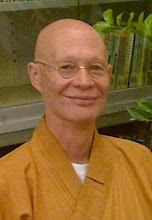
T'ai Shen Centre: A space for Chinese Pure Land Buddhism

Mindfulness within our Buddhist Practice is not just some technique but a total way of life. The ways of the world are concerned with creating results. Our practice is about creating Causes - the causes of Compassion, Wisdom and Happiness for all beings.


Saturday, March 6, 2010

Is that all there is?


Once in Shandong Province China there was a beggar who came to a temple to beg for food. He was greeted by the abbot of the monastery, a very compassionate Master or Pure Land. The old abbot had great compassion on the beggar and told him that if he would travel to a particular rural village he would find a great treasure where the roads intersect.

In delight the beggar set off and finally reached the village. When he found the two intersecting roads he searched in vain but could find no treasure. Disappointed and tired from his long journey he sat down on an old dusty wooden box in which the local farmers would store corn cobs. “Is that all there is!” he sighed in despair, “this decrepit old box full of rocks?” He departed the village disappointed.

Not long after a poor farmer wandered by with his wife and three children. He noticed the old box beside the road and inquired of a passer-by who had left the box there. “I don’t know” replied the village man. “It appeared yesterday morning. Perhaps it is rubbish which someone has left.” The poor farmer was curious. He tried to move the box with his foot but it was heavy. He found a branch from the tree which he broke to make a lever and with great effort prized open the box. To his great astonishment and joy the box was full of gold bars. Out of honesty he immediately notified the village mayor who moved by the poor farmer’s honesty allowed him to keep the gold.

Is that all there is? Many seekers of Pure Land are disappointed as all they see is the seemingly “boring” repetition of the Buddha’s name. Many come seeking profound meditation experiences hoping to see visions, brilliant colours or mind altering experiences. While it is certainly not impossible to have these experiences from Meditation or Buddha Name Remembrance they are to be treated with great caution as they are illusory and impermanent. Such seekers have missed the point and in doing so have foregone a great treasure.

Each repetition of the name of Amitabha Buddha is like a small droplet of pure mystical water falling into our life pond of muddied, stagnant water of lifetimes of negative karmic residue. Each droplet displaces the muddied water until eventually the water become clear and reflects the light of the sun and moon and we can see ourselves as we truly are, a reflection of the Buddha, our Buddha nature. It is then we recognize a treasure of a lifetime and are truly blessed.

Amitofuo

Saturday, February 27, 2010

Want to see a miracle?


I was some time ago talking to my Master in the grounds of the Temple. It was a sunny Spring day. The Camphor Laurel trees exuded a beautiful perfume and the leaves rustled like soft whispers of a mantra. Our conversation turned to miracles. I mentioned that many people would like to see miracles occur in their life (trying hard to hide the fact I was also referring to myself!!). "There is one happening right in front of you at this very moment if you look carefully" he stated. Thinking that he was making some reference to our dialogue I nodded that I understood. Then he laughed. Oops!!! Had I misunderstood due to my inferior Chinese? He pointed "这里!Zheli! zheli!. . .here! here!" He pointed to the ground near my feet. In his sharp vision and wit he had seen something and transformed it to a lesson for me. There I spotted a single ant carrying the carcass of a large grasshopper. "Could you do that? Could you carry something by yourself nearly eight times larger than you?" came the Venerable. "We just need to open our eyes." . . .and perhaps the eyes of our mind, I thought.

Sunday, February 21, 2010

Talking Heart, Walking in Sunshine


Talking Heart, Walking in Sunshine - that is what is meant by the Chinese characters 总是(Zong Shi)meaning “always/continually”. It is a beautiful picture. This is what occurs when we live out a life of Pure Land Buddhism. It is not something that one practices when one is in the mood or when things go wrong. Sadly this happens with so many people. Pure Land Buddhism is a path to walk every day, every moment of the day. Pure Land Buddhism encompasses all areas of our life because all of our life is interrelated. It is holistic. Our spiritual life cannot be separated from our relational life. Our physical life cannot be separated from our mental (thinking) life. Yet our Western thinking is so dominated by the desire to place things into categories. This is fragmentation thinking!

Pure Land Buddhism and in deed all of Buddhism understands life to be interconnected and interdependent. If we try to maintain a spiritually whole life and at the same time emotionally bully another, tell “little white lies” or live up to less than our calling then this will have consequences not only in our spiritual life but also in other areas of our life. I like to speak of Five Foundations. Each pillar of the Five Foundations is interdependent upon the others.

The Five Foundations

Right Spirit:

• Refers to our spiritual being, our sense of Truth and ethics and Bodhi Mind.
• Common spirituality of all humans.
• Daily ritual - mantra, meditation, prayer, silence
• Connectedness to a whole greater than ourselves
• Sense of awe and wonder, beauty
• Our sense of awe and wonder can be interrupted by injustices to others or ourselves. These MUST be corrected before spiritual balance is gained.

Right Thinking:

• Thoughts need to be positive and empowering.
• Can be injured by harbouring resentment and anger.
• Emotions and logic need to be balanced
• Education and continued learning is important


Right Relationship:

• Must not be exploitive, emotionally violent or abusive, nor sexually illicit.
• Needs to evolve from compassion
• Refers to communal as well as interpersonal
• Needs commitment

Right Consumption:

• Consumption of alcohol - consumption of meat - junk food - all damaging.
• Include vegetables - fruits - herbal foods
• Proper and just distribution of food throughout the world.

Right Movement:

• Refers to the movement of body, blood, and breath.
• We are designed to move
• Exercise needs to be regular, rhythmic and moderate
• Include breathing exercises as part of daily maintenance.


click on image to enlarge


Right Spirit

It is important to have daily practice in our spiritual life. Jing Tu (Pure Land) Buddhism is perfectly situated for this. Take time each morning to practice the morning devotions and meditation. Be diligent in reading Dharma materials and sincere and compassionate in our dealings with those about us.

Right Thinking

One of the biggest myths of life which abounds is that it is the things that happen to us which make us what we are and what we feel. THIS IS A MYTH! It is no more than our thinking ABOUT what happens to us that make us feel or react the way we do. Once we understand this we are well on the way to a happier life. We may not be able to change events but we are able to change our thoughts and thinking patterns. Unfortunately rigid patterns of thinking have often developed over years. In our meditation we have the opportunity to re-examine these thought processes.
All our actions and behaviors evolve from our thoughts. If our thoughts are pure and focused then our actions and results will be successful, harmonious and growthful.

We also need to check the balance of Emotions and Logic. Sometime we are completely overruled by our emotions rather than looking at facts and rational thoughts. Other times we can ignore the colour of our emotions and the signals they give us upon which we can make rational decisions.
Anger and resentment can tear our life apart and are the causes of much hostility and violence. We must check our anger. Peace can only be attained in our world when it is first attained in our hearts and minds.

Right Relationship

Whole books have been written on right relationships. By relationships we are not just referring to male/female relationships but our relationship to the entire creation. Consumer living can erode our ties with the natural order as we forget our relationship with the cosmos, with our environment and all living creatures.
Many relationships can be exploitive getting what we can from them. Many relationships are one-sided with one partner giving more than the other. This can harm our mental and spiritual wellbeing. Relationships need quality time and the space to mutually give and receive in a totality of commitment.
We see in modern times families are so busy in making money that they have forgotten their parents placing them in nursing homes to be cared for by others. Buddhism places great emphasis on care of our parents and family.
Human beings are not isolated islands. We exist, learn, grow and become whole people in relationship with others.

Right Consumption

There is clear evidence of the relationship between diet and physical as well as mental well-being. Depression can, for example, often have its roots in poor or sugar loaded diets. To live a balanced life we must be considerate as to what we place into our bodies. Right Consumption also means the just distribution of food throughout the world. It is immoral that over 60% of the western world’s population is obese when millions go hungry.
As people of the Way we must sincerely avoid the consumption of alcohol meat and other intoxicants (cigarettes and illegal drugs).

Right Movement

Human beings were designed to move. Proper moderate exercise is vital to our physical, mental and spiritual well-being. Walking, swimming, yoga, T’ai Chi, Qi Gong, tennis, badminton or many other sports are good for one’s health. Many sports like tennis and badminton or volley ball also enhance social relationships. In China in the early morning hours in town squares you can see many people gathered together to practise their favorite movement and enjoy social interaction at the beginning of the day.
When we take these Five Foundations into serious consideration we can begin to live a much healthier and happier life.
When our practice spans across all areas of our life on a continual basis sunshine comes into our heart. . . “zong shi”.

Monday, February 15, 2010

On the Other Side


One day a young monk on his journey home came to the banks of a wide river. Staring hopelessly at the great obstacle in front of him, he pondered for hours on just how to cross such a wide barrier. Just as he was about to give up his pursuit to continue his journey he saw a great teacher on the other side of the river. The young monk yells over to the teacher, "Master, can you tell me how to get to the other side of this river"?

The Master ponders for a moment looks up and down the river and yells back, "My son, you are on the other side!".

Often in our life journey we long to get over to the "other side", whatever that may mean to us individually. "The other side" may mean that other city where life could be better or those "if onlys": If only I could have enough money for this or that; If only I could meet that magical person in my life. The problem is that the "here" will always be "there" and the "there" "here".

Where we are at this moment is the only place and time of our journey. In Pureland Buddhism we focus on our mind and the Buddha Mind becoming one through the practice of "nianfo" or Buddha Name Remembrance - the constant repeating of the name of Amitabha Buddha. The Chinese character for "nian" 念 means placing the mind (heart) in the present moment. The Buddha moment is now.

At a recent workshop in Mindfulness a participant presented his problem as trying to live the spiritual life while having to live in a worldly world. He went on to describe his struggles. While this is a very common struggle with those truly seeking to live the spiritual life the very struggle is where we need to be. It provides the necessary food for the journey. The small seed struggles against the very thing in which it is rooted - the soil - as it pushes against the clay to reach the light of day as a small green shoot. The butterfly pushes its wings against its cocoon in its attempt to free itself from its confines and in the process its wings are primed and strengthened. I am sure the seed and the butterfly yearn for the "other side"!

When we focus our mind in the now moment breathing in and out the name of Amitabha Buddha the name becomes like a vessel rescuing us as we bob about in the worldly ocean.

Searching for "the other side" is an necessary struggle. Our journey is most often on the side where we are at now.

Saturday, January 23, 2010

Seek Joy not Happiness


Seek not happiness in life. Why settle for second best? Seek pure Joy. Happiness depends on what happens to you. Pure Joy has no limitations.

Joy is an abiding state. It has no conditions attached – no small print at the foot of the page. It is not dependent on status, race or creed. It comes not as a result of economic conditions or political policies. It is for all people of all times and all places.

That is what the Buddha came to show us. He observed and was deeply affected by the joylessness in life. Many, including fellow Buddhists, miss this point. It is often stated that the Buddha came to show us a way out of suffering. No! He came to show us Joy and that we may all directly experience this. But, I hear you say, isn’t this the same thing? Almost! Except it falls short of the mark. The former seems to be afraid of naming it. We are so entrenched in our suffering that we are often afraid to proclaim its antidote. We are like blind people stumbling across a jewel and then ending up in endless debate about what we have found.

Happiness depends on what happens to us; thus its name – “happen-ness”. Happiness so often depends on moods, feelings, ideas and even values. Joy, on the other hand, transcends all these things. Happiness is a brightly decorated spider that the poor insect mistakes for a beautiful flower. When the insect thinks it has attained this flower the spider then grasps the insect. It is unable to escape the sticky web and eventually its fate is sealed by the poisonous fangs of the spider.

The Buddha experienced these things in his life. He found an antidote, a path to untangle the web of ignorance and lead us to Joy.

Joy is like the air we breathe. It is vital and fresh, pure and enhancing. However, in ignorance we have built houses and palaces of happiness whose walls have blocked out the fresh air of Joy. We will soon perish of asphyxiation in this condition.

Joy is pure being. When we begin to pull down the walls of self-cherishing and attachment then we will be able to breathe the fresh air of Joy. It is this Joy that is limitless.

My wish for the world and for you my dearest friend is everlasting Joy. May you practice its path and share it with others on the journey.

Friday, January 22, 2010

Wise Up to Down Time


Mention the notion of Buddhist meditation and one most often conjures up the image of someone sitting in the lotus position, back straight, eyes closed and in peaceful contemplation - a perfectly normal and acceptable image. However, as most of us know who try to jam in twenty minutes or so of meaningful meditation in the morning before topping up the caffeine levels, racing out the door to pack into the bus or train or join the line of the other thousands of cars on the peak morning not-so-freeway bustle, finding the quality time to stay in tune with our Buddha consciousness can be quite a daunting task.

On the other hand Pureland Buddhism puts us in contact with the reality of each moment of the day, even during those stressful or irritating times hanging on the end of the phone line in the office while waiting for the automated voice telling you what number to press for half a dozen services you don’t want or feeling your blood pressure rocket past “normal” while waiting for the traffic to move past the tenth change of traffic signals. In fact, Pureland Buddhism is perhaps the most suitable method of practice for the modern era.

In my early days of practice of Pureland Buddhism I found I often bemoaned the seeming lack of time I had to practice meditation and Buddha Name recitation or “nien fo” as it is termed – that is until one day I discovered the wonderful Law of Downtime. It was before the time of the Navcom and I was racing out of the office to see a client in a southern Brisbane suburb. I failed to do my pre-drive check of the street directory instead navigating the car in a southerly direction. I soon realised I had no idea of where the destination address was so had to consult the street directory while at the same time steering the car. I am not sure if any of the readers of this blog have tried this (and I don’t suggest you do) but it is quite dangerous and difficult. Suddenly I found myself at a set of annoying traffic lights at an intersection I was acquainted with and I knew it normally takes what seems a millennium for the lights to change. So, I took this golden opportunity to consult the street directory. Well, you know what happened? Yes, you are right. The lights changed almost immediately just as I had fond page 230 in the street directory. At each set of lights the same thing happened leaving me no time to locate the destination address and plot a course. I could have sworn the Transport Department had changed the timing sequence on the lights! Alas! No! What had happened was that I had discovered the Law of Down Time: Traffic lights will always change quickly when to are pre-occupied with something else.

The central focus of Pureland Buddhism is to develop the Bodhi and Pure Mind through Buddha Name Recitation. “Once having developed deep Faith and earnest Vows you should hold on to the words “Amitabha Buddha” (Namo Amitofuo). Regardless of the occasion, weather walking or standing, sitting or reclining, speaking or remaining silent, moving about, meditating, dressing, eating, even when in the privy, you should keep the words “Amitabha Buddha” firmly in mind. You should exert yourself until the recitations are constantly before you, the whole Buddha is Mind, Mind and Buddha are one - reciting to the ultimate point where all mundane feelings are forgotten. At that time, the mind being empty, the Buddha appears. During this life you can attain the Buddha Name Remembrance Samadhi and at the time of death achieve rebirth in the upper lotus grades” - Master Yin Kuang, Pure-Land Zen, Zen Pure-Land, Letters from Patriarch Yin Kuang. The 13th Patriarch of Pureland Buddhism, Venerable Yin Kuang, makes it clear the necessity to hold the Buddha Name in all situations. If you become aware of Down Time you will find many such opportunities during the day: Standing in the line in the bank, waiting for traffic lights to change (they change a lot faster!!), waiting your turn at the check-out at the supermarket, waiting on the end of the phone, going through the security check at the airport, and so on it goes. Down-Time becomes the perfect opportunity for Buddhist Mindfulness practice.

Maximize your Down-Time moments for de-stressing instead of getting all wound up. Follow your breathing. Breathe in a gentle breath while in your mind saying “Amitofuo” (Amitabha Buddha). Allow the lungs to empty naturally while again holding the thought “Amitofuo”. Each breath: “Amitofuo”. If the mind pulls you into one of its stories simply acknowledge it by saying: “Thank you Mind” then continue the breathing and Buddha Name recitation. Observe how you feel at the end of each Down Time Session and make the Down-Time as an offering with deep thanks to the Buddha.

I invite you to make a written list of Down-Time opportunities in your day. No, don’t put it off until you have a moment. Do it now! – a short simple list is good to start with. You can add to it later when you discover more moments.

If you are not Buddhist you can still use this method adapted to your own faith tradition or simply to de-stress by doing some gentle awareness breathing. Notice what a difference to your day and your attitude it makes. Bring your meditation with you throughout the day and make a real difference to the world around you.

The line in the post office snaked its way out into the shopping centre mall. I closed my eyes and drifted deeply into my breath with the Buddha of Infinite Light and Life as my focus. Time stood still. All was gentle and peace. Suddenly I was aware of a soft tap on my shoulder: “Excuse me, Sir. It’s your turn.”

Sunday, January 3, 2010

POSITION VACANT


I need a dedicated, reliable and motivated person to assist me in presenting Mindfulness Training and other courses in China. This an excellent opportunity for the right person to make a meaningful contribution in people's lives.

You must be fluent in both (Chinese)Mandarin and English. A knowledge of Chinese Buddhism and a passion for Chinese culture is highly desirable. If you are living near Hangzhou or Shanghai or know of anyone in this area this position would ideally suit you (them).

As much of the training work happens in the Tianmushan/ Lin'an region the ability to have fun working in a rural and remote environment is essential as is being warm, welcoming and encouraging to participants.

I am not interested in what degrees you have or don't have as much as I am interested in your passion for humanity and ability to "travel the journey" with another as they take the challenge to make changes in their life. If you can learn new skills quickly that is great!

If you are interested please contact me and I can forward more complete information.